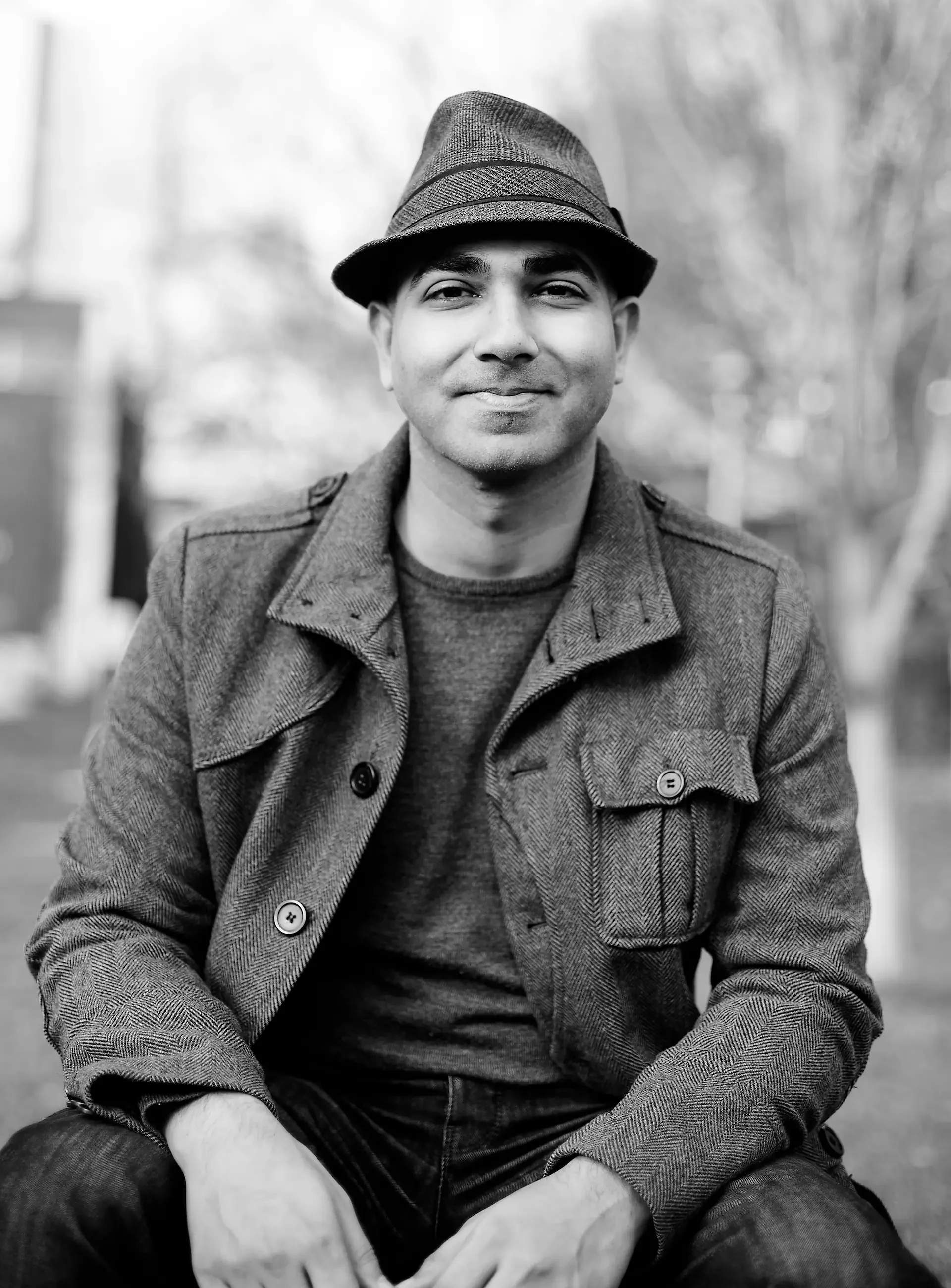
Why, hello. My name is Reuben and I'm a mastering engineer, music lover, and audiophile.
I take your mixes and apply crazy voodoo with my knowledge of the mastering black arts to create records that make people go "OH YEAH!!" [insert Kool-Aid Man gif]
** Humble brag alert **
My clients get nominated and win cool awards. When they do, I dance a little jig. [See the full list →]
If you'd like to learn more about my mastering philosophy, background, and gear, you'll find all of that below.
FAQ (You have questions, I have answers)
-
I think the main thing to consider when selecting a mastering engineer is their unique point of view. What are their aesthetic preferences? How do they hear music? What are they looking for in a great-sounding record?
Anyone can purchase gear and a studio these days. It's more accessible than it's ever been. And with how good the quality of both analogue and digital equipment is now, any competent mastering engineer should be able to deliver great masters with whatever they're given. So, I won't concentrate on gear here (I will say that I LOVE vacuum tubes and transformers! When it makes sense to use them in my work, I will).
So, how do we choose? What's the engineer's unique point of view?
I'll tell you mine.
I think great records should capture the artist's attitude, vision, and vibe. The record should be engaging and provocative. A great-sounding record will support this, whatever its sonic characteristics might be. As a mastering engineer, it's my job to deliver a master that best displays the artist's vision.
That said, there are audio characteristics I prefer, all things being equal.
I have a strong preference for records that have great bass. The bottom end should be big and full, but never boomy or bloated. It should support the melody and envelop the listener.
The record should have depth. I don't get as fussed about the left-right width. But I want there to be layers from front to back. This is a key element to what I think of as complexity in the soundstage, similar to how great wine will have complexity, layers, and nuance.
I want to hear all the tonal colours that the music has to offer. This is a tricky thing to quantify. But try this: put on one of your favourite-sounding records. Close your eyes and just listen. Try to hear the music in terms of the tone colours emanating out of the speakers towards your ears.
A great recording will feel like there's an explosion of colour coming towards you. A lesser recording might feel more monochrome. A bit flat. We shouldn't hear just black or white, but all the thousands of gradations in between.
I want to feel like the woofers are pushing air towards me. This is related to dynamics. A dynamically flat recording won't present this sensation. But a recording that moves and pushes air can allow the listener to "feel" the recording on a visceral level.
This last point is unrelated to the actual loudness level of a record. I've heard loud records that have great dynamic sensations. And I've heard quiet ones (low LUFS) that feel flat. Like every engineer, I prefer records that aren't over-compressed or limited. But if the artist's preference is for a perceptually loud record, there are ways to achieve that while still being able to move air.
How does one achieve all of this in the mastering process?
The mastering engineer should have a clear vision of how the record should sound in their head, taking into account the artist's vision and preferences.
And then they should use the tools at their disposal (primarily equalisation) to achieve that sound with the least amount of processing possible. Over-processing is the most common path towards a flat, dry, monochrome-sounding record.
I believe that the most direct, minimalist mastering approach is the path to vibrant, colourful, dynamic records. This is the way to preserve all the layers of complexity and nuance that the artists put into their music.
-
I started my mastering journey in 2007, when I worked for Phil Demetro at The Lacquer Channel. Other job opportunities arose, so I wasn't there long. But even so, it set me off in the right direction. I was able to observe how real mastering was done, which was (and still is) very different from what you'll read on the internet or in books. Without this experience, it could have been very easy to veer in the wrong direction with my mastering work, because there is so much misinformation out there.
As I worked in other parts of the audio industry (recording and mixing, broadcasting, commercials, etc.), I continued my mastering journey on the side. Because of my experience at the Lacquer Channel, many of my engineer and producer friends called upon me when they needed mastering done. Eventually, mastering became the bulk of my work, so I went full-time in 2012, when I established Mojito Mastering.
Since then, I've mastered over 3,000 projects, and have learned something new from every one of them.
-
Sure did! I have an M.Mus. in Sound Recording (Tonmeister program) from McGill University (2005). I also have a B.Mus. in music from McGill (2003), where I studied Music Technology and Jazz Piano.
I also spent three semesters at the Banff Centre (2004–2006) in their audio work-study program.
More recently, I've been working with the legendary Vlado Meller to improve my mastering work. In 2020, I felt like I wanted to take my work to another level and was looking for ways to accomplish this. I initially signed up for an in-person workshop with Vlado Meller, which was scheduled for March of 2020. Well, we all know what happened then!
It turned out to be a blessing in disguise, as we ended up working one-on-one together (on Zoom) rather than the group setting that was initially planned. We spent three days going through many of my masters, where he provided valuable feedback and advice. After those sessions, we've kept in touch and Vlado has continued to provide guidance for my work.
Learning from someone with the experience and knowledge that Vlado has has been an absolute game changer. It has transformed the work that I'm capable of, and I wouldn't have been able to achieve this level in any other way.
-
Before I started mastering full-time, I did a lot of things in the industry. I was a freelance recording and mixing engineer for a long time.
I worked for five years at CBC Music as a Recording and Broadcast Engineer and Digital Media Producer.
I've worked at Humber College for many years, first as a recording and mixing engineer, and later as a mastering engineer. I even taught a course one year!
I worked in post-production (film, TV, commercials, etc.) at Apollo Music as their head engineer.
And before I became a pro, I interned at a few Toronto-based studios: D.A.V.E. Audio (became Technicolor), Reaction Studios, and Phase One Studios.
-
Ooh boy! Now we're talking! My monitoring system is something that's near and dear to my heart.
I use a pair of incredibly unique speakers, custom-designed by Austrian speaker designer David Haigner and built by myself.
What makes them special? Time domain. I've found that the majority of speakers used for mastering (and mixing, for that matter) don't prioritise the time domain. They may have a great frequency response, but that's only one aspect of music reproduction.
Music is all about time! We don't listen to sine waves and pink noise. What makes music "music" are the spaces between the notes. And in order to reproduce that accurately, we need a monitoring system that has an accurate impulse response.
David's speakers are all designed with that in mind, and these are no exception.
In addition to the time-domain properties, these have a minimalist first-order crossover, high sensitivity (requires very little amplifier power), and have separate amps handling the low and mid-high frequency ranges (bi-amping). All of these contribute to a very low distortion system, both in terms of harmonic distortion, as well as time-related distortion.
What that translates into are speakers that display the full spectrum of colours, tones, and dynamics within well-recorded music. And conversely, when a recording isn't up to par, they put a spotlight on the recording's deficiencies. When listening with these speakers, the contrast between excellent recordings and subpar recordings is greater than any monitoring system I've ever experienced.
This gives me a unique perspective that allows me to deliver masters that wouldn't be possible with mainstream mastering monitors.
-
I use a hybrid analogue-digital setup. After extensive testing, I've found that the primary benefit of analogue gear in a mastering setup is gained by simply running through the components themselves. Tubes, transformers, transistors, etc.
With the actual EQ or compression work, it didn't seem to matter if I did it with digital or analogue gear. For instance, I could get the same results by doing the EQ work digitally and then running it through my analogue chain, as I would by doing the same curves with an analogue EQ.
With this in mind, getting the most out of both worlds made the most sense. I could get the precision and repeatability of digital tools, with the colour and tone of analogue.
I should also note that not every project needs analogue processing these days. Ten to fifteen years ago, things were different. But now, a lot of the mixes I see already come in with a lot of tone and colour, and staying in the box can be the best solution for these. The way I have things set up, I can insert my analogue chain at unity gain on any project and test whether it's improving the project. This way, I'm not blindly adding gear to a project no matter what. I'm deliberately choosing the best approach for each project.
For my analogue gear, it mostly comprises custom tube and transformer equipment that I've built myself, or that was custom-built for me.
I change around my chain often, but here are a few pieces of equipment to give you an idea of what I might be using:
Audio Note DAC 4.1 (Vacuum Tube and Transformer DAC using 5687 tubes, a tube-rectified power supply, and gigantic audiophile-grade transformers)
A passive transformer "tone" box, using 1962 Western Electric 111C transformers
QES PAD-1 ADC. This is a transformer-based analogue-to-digital converter. I had some custom modifications done to make it align more with my preferences. Sadly, the creator, Val, passed away a few years ago. So, no more of these will ever be made. This unit is now somewhat of a rarity, and I'm fortunate to own one.
Digital Tools:
EQ:
My main EQ that I use on almost everything is the Weiss EQ. The hardware units were used in every major mastering studio for over 30 years for a reason. It's quite simply the best equaliser I've used, analogue or digital.
We're fortunate to now have the exact processor (1:1 code port) available as a plugin. It sounds exactly the same as the hardware, but with the advantages of a plugin (repeatability, multiple instances, etc.). Analogue or digital, this is the most important piece of my chain.
I will sometimes use the Tokyo Dawn Labs EQs, or the Ozone Vintage EQ. But that's about it. I try to keep things simple, and I rarely need to reach for anything else.
I have other EQs available, including many analogue emulations. But in blind listening tests, they rarely win over the ones mentioned above.
Compression:
I don't use compression that often—most projects only need a limiter. But when I reach for one, it's the Weiss DS1-MK3 or the SSL Native Bus Compressor 2.
I will sometimes use multiband compression in the bass region. Ozone usually works best for me. I will sometimes reach for the Leapwing Dynone, but I prefer Ozone's workflow, and the sound is very similar.
De-Essing:
Bob Ludwig once told someone that his Weiss DS1 was his most important tool, and he was specifically referring to its use as a de-esser. Not that I would argue with Bob Ludwig anyway, but boy was he right!
De-essing is such an important part of the mastering process because many engineers don't dial in the sibilance enough. And lesser de-essers tend to make the overall track feel dull before they actually fix the sibilance. Having a great de-esser is VERY important.
The Weiss de-esser is the best mastering de-esser I've used… full stop. I can dial in the sibilance on the vocals without softening things like the snare or hats.
You might be seeing a pattern here… the Weiss stuff might be expensive, but there isn't much better out there. Daniel Weiss is a genius!
Limiting:
It's important that mastering engineers test a few different limiters for each project. Every limiter has its own tone, and matching the limiter to each project is one of the most crucial parts of modern mastering.
These days, I tend to use Ozone, Elevate, Weiss, and FabFilter. But sometimes, I'll try out others to see if they can beat my regulars. It's important to continue to see if you can find something that can improve your work. But most of the time, the ones I mentioned above sound best.
Upward-expansion, multiband spectral harmonic distortion, voodoo, etc.:
Just kidding! None of that stuff is necessary, and is usually detrimental. Most mastering engineers whose work I've studied don't touch this stuff. And there's a good reason for that.
Whenever I try these types of processors, I always do a blind, volume-matched listening test after. Masters with this type of processing never win when compared to simpler, minimalist approaches.
Great mastering is about doing less, not more.
I will do some basic mid-side widening or narrowing sometimes. Narrowing, you say?! Why would I ever do that? Sometimes, some very subtle narrowing can help emphasise the drums and help the track groove a bit harder. Any mid-side plugin will work for this.
DAW:
I use a highly customised version of Reaper. I've added a lot of custom code and actions to make the workflow amazing for what I need. And sonically, it's as good as anything else on the market. No complaints.
Sample rate conversion, dither, de-clicking, etc.:
iZotope RX. It's the best there is.